Comparative: Anker Soundcore Space One vs JBL Tune 770NC — which budget ANC headphones under $100 are worth it
Two of the most recommended budget noise-cancelling headphones, each betting on a different strength: more refined sound on one side, absurd battery life on the other.
Main keyword: Anker Soundcore Space One vs JBL Tune 770NC
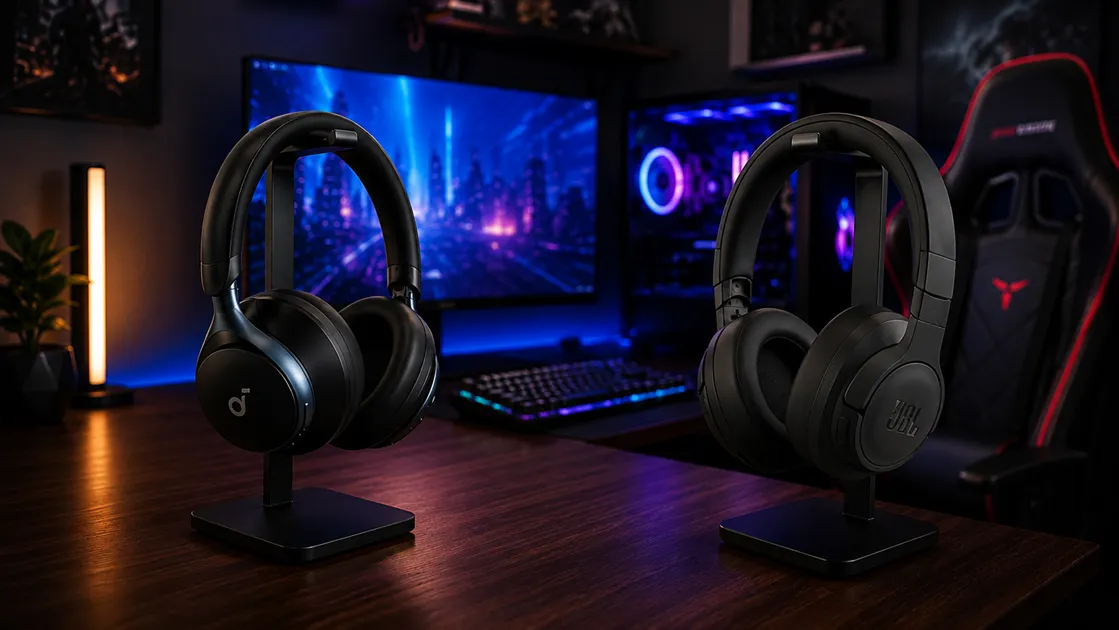


Why compare these two
Both compete on the same shelf: over-ear headphones with ANC, plastic instead of metal, and prices under $100 — the most competitive segment of the personal audio market today. The difference in approach shows up fast: the Space One bets on Hi-Res audio via LDAC and a more sophisticated app EQ; the Tune 770NC bets everything on battery life, with runtime that leaves any competitor in this price range far behind.
Battery: the biggest difference between the two
There's no contest here — the JBL Tune 770NC simply plays in a different league. Battery life is rated at 70 hours with everything off, dropping to 44 hours with ANC and Bluetooth both active, and it charges up to 3 hours of use in just 5 minutes on the charger. Real users confirm this number: reports of charging the headphones only twice in an entire year of use aren't uncommon.
The Soundcore Space One comes in at up to 40 hours with ANC on and 55 hours without ANC — good for the price range, but visibly behind JBL on this specific point.
Sound quality and features
The Space One has the edge in technical features: LDAC support for Hi-Res audio (rare at this price point) and an app with more complete adaptive EQ. JBL, meanwhile, sounds good "out of the box," without needing much tweaking in the app — the Tune 770NC has a balanced sound signature, with a 10-band EQ in the app for anyone who wants to adjust it, but those who've tested both side by side tend to find the Space One less balanced on this specific point, despite the LDAC support.
| Item | Anker Soundcore Space One | JBL Tune 770NC |
|---|---|---|
| Battery with ANC | Up to 40h | Up to 44h |
| Battery without ANC | Up to 55h | Up to 70h |
| Fast charging | 5 min = 4h of use | 5 min = 3h of use |
| Codec | LDAC (Hi-Res) | Standard (no LDAC) |
| Multiple connection | Yes (multipoint) | Yes (multipoint) |
| Wired input | No | Yes (3.5mm) |
| Bluetooth | 5.3 | 5.3 |
| Reference price | ~$110–130 | ~$99 |
Pros
- + JBL Tune 770NC has by far the best battery life in the category
- + Soundcore Space One has LDAC, a rare feature at this price point
- + Both have multipoint connection and app-adjustable EQ
- + JBL Tune 770NC has a wired input (3.5mm), the Space One doesn't
Cons
- − Neither has automatic wear detection
- − Both can get warm around the ears during very long sessions
- − ANC on both struggles in very noisy environments or with strong vibration (buses, for example)
- − Both are 100% plastic construction, with no premium finish option
Frequently asked questions
Anker Soundcore Space One or JBL Tune 770NC: which has better battery life?
The JBL Tune 770NC wins by a wide margin, with up to 44 hours with ANC on and 70 hours with ANC off, compared to up to 40 hours and 55 hours on the Soundcore Space One.
Which one has better sound quality?
The Soundcore Space One has the edge in technical features, with LDAC support for Hi-Res audio, rare at this price point. The JBL Tune 770NC sounds balanced right out of the box, but without that high-resolution audio support.
Does the JBL Tune 770NC have a wired connection?
Yes, it has a 3.5mm input for wired use, something the Soundcore Space One doesn't offer.
Do both have good noise cancellation?
Both are effective against constant ambient noise, like office and travel settings, but struggle in very noisy environments. The JBL Tune 770NC specifically has trouble with the strong vibrations of bus rides.
Which one is more comfortable for extended use?
Both have similar comfort complaints during very long sessions — the JBL can get sweaty around the ears, and the Soundcore Space One has relatively shallow cushions. Neither clearly stands out over the other here.
Is it worth paying more for the Soundcore Space One over the JBL Tune 770NC?
Only if you actually use Hi-Res audio via LDAC or value a more complete EQ app. For those who just want the basics done well with the best possible battery life, the JBL Tune 770NC delivers more for the money.
Nota de transparência: este conteúdo pode conter links de afiliado. Se você comprar através deles, o Decode Layer pode receber uma comissão, sem custo adicional para você.
Noise cancellation
Both have similar limitations: good against constant ambient noise (office, plane, traffic), but weak in specific situations. The Tune 770NC works well against low-frequency noise like AC hum, but doesn't block everything in very crowded or noisy places, and specifically struggles with the strong vibrations of bus rides. The Space One follows the same pattern: effective for travel and office use, but with limitations in very noisy environments.
Build and comfort
Both use plastic — neither is "premium" in terms of finish. The JBL is lightweight and comfortable, but can get sweaty around the ears during extended use, a common issue with closed-back headphones. The Space One has the same type of complaint, with relatively shallow cushions. Neither has wear detection — the JBL specifically lacks this feature, which pauses your music automatically when you take the headphones off.
Verdict by use case
Choose the JBL Tune 770NC if battery life is your top priority — the runtime difference is big enough to mean charging once a month instead of once a week, and it also has a wired input, useful if the battery dies during a trip. Choose the Anker Soundcore Space One if you have a Hi-Res audio source (high-quality streaming) and want to take advantage of LDAC, or value a more complete EQ app. For anyone who just wants the basics done well and doesn't care about Hi-Res audio support, JBL has the edge with its battery + wired input combo.
Where to buy
JBL Tune 770NC - Wireless Over-Ear Headphones - Blue | Adaptive Noise Cancelling with Smart Ambient, Bluetooth 53 with LE Audio, JBL Pure Bass Sound — $ 89.95. Buying through the link below supports Decode Layer at no extra cost to you.
Affiliate link. As an Amazon Associate, we may earn a commission from qualifying purchases.