What a qubit actually is, without the jargon
A classical computer bit is always either a 0 or a 1. A qubit — a quantum bit — can exist in a state that’s a mix of both 0 and 1 at once, a property called superposition. Qubits can also be linked together through entanglement, where the state of one qubit is tied to the state of another, no matter how the system evolves.
Neither of these properties makes a quantum computer “faster” in the way a faster CPU is faster. What they enable is a fundamentally different way of exploring a problem: instead of checking possibilities one at a time, a quantum computer can explore many possibilities simultaneously through the mathematics of superposition and interference. This is only genuinely useful for specific kinds of problems — certain types of chemistry simulation, optimization, and cryptography-related math — not for everyday computing tasks like browsing the web or running a spreadsheet.
The problem that held the field back for a decade: errors
Qubits are extremely fragile. The slightest interference from heat, electromagnetic noise, or even cosmic rays can cause a qubit to lose its quantum state — a process called decoherence. For years, adding more physical qubits to a quantum computer actually made the error problem worse, not better, because more qubits meant more opportunities for something to go wrong.
Quantum error correction (QEC) is the technique that fixes this: it combines many unreliable physical qubits into a smaller number of much more reliable “logical qubits,” detecting and correcting errors as they happen. The theoretical concept existed for decades, but building it in working hardware, at a scale that actually helps rather than adds more overhead than it saves, was the field’s central unsolved problem — until 2026.
What actually happened in 2026
This is the part that separates quantum computing’s 2026 status from years of “just around the corner” headlines: multiple independent teams, using different hardware approaches, demonstrated error correction that works below the “break-even” threshold — meaning that adding more qubits to the error-corrected system now reduces the overall error rate, instead of increasing it. That’s the specific technical condition theorists have pointed to for years as the dividing line between a physics experiment and a genuine engineering foundation.
A few concrete milestones from 2026:
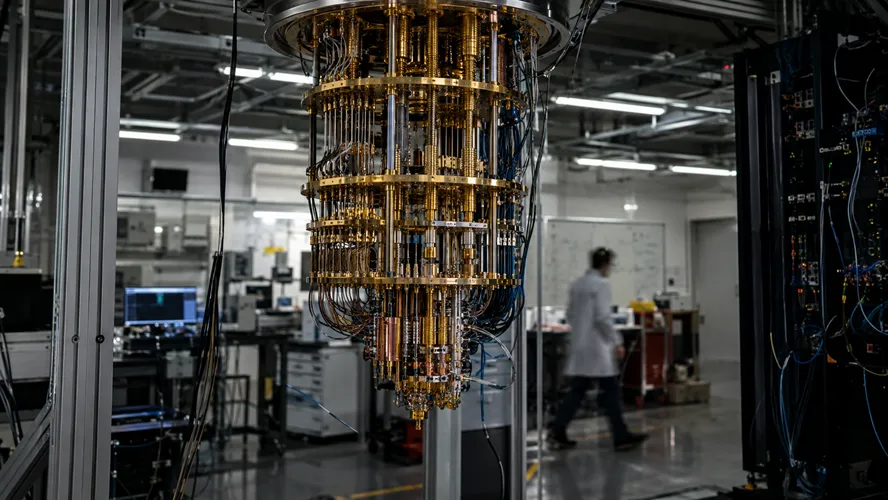
- Google’s Willow processor demonstrated exponential error suppression — logical error rates that decrease as more physical qubits are added, rather than accumulating.
- Microsoft and Quantinuum jointly announced a working system combining qubit-virtualization with real-time error correction, describing it as marking the start of a “resilient” era for quantum hardware.
- QuEra published results in Nature demonstrating 96 verified logical qubits built from 448 neutral atoms, using error-correcting codes that require higher qubit connectivity than earlier approaches.
- Quantinuum announced 94 logical qubits on its H-series processor.
- Across the industry, two-qubit gate error rates dropped below the 1% threshold on multiple hardware platforms — a level considered viable for practical error correction.
IBM’s public roadmap, echoed by competitors like Quantinuum, targets large-scale, fault-tolerant quantum computing by around 2029.
What quantum computers still can’t do
It’s important to separate “error correction works” from “quantum computers are now useful for real problems.” As of 2026, that second part hasn’t happened yet. The demonstrations achieved so far show that error correction itself functions — not that an error-corrected quantum computer has solved a real-world, commercially meaningful problem faster than the best classical computer could. Researchers and companies involved have been explicit about this distinction, describing 2026 as a year of “demonstrated benefit,” not “final arrival.”
The field has also shifted its own vocabulary to reflect this. For years, the headline metric was “quantum supremacy” — beating a classical computer at a contrived, often practically useless task, purely to prove it was possible. The industry has largely moved on to talking about “quantum utility” instead: solving problems that are actually useful, even if a classical computer could technically also solve them, just far more slowly.
Why quantum computers won’t replace your laptop
Quantum computers are not a faster version of the computer on your desk — they’re a fundamentally different tool, useful only for a narrow category of problems where the quantum approach offers a genuine mathematical advantage: certain molecular and chemistry simulations, specific types of optimization problems, and parts of modern cryptography. For the vast majority of computing tasks — running an operating system, rendering a video, browsing the web — a classical computer remains not just adequate, but the only sensible choice; quantum hardware doesn’t help those workloads at all. Most experts expect quantum computers to function as specialized accelerators inside larger classical computing systems, not as standalone replacements for anything you use day to day.
Frequently asked questions
Are quantum computers faster than regular computers?
Not in general. They're dramatically faster for a narrow set of specific problems (certain chemistry simulations, optimization, and cryptography-related math) where the underlying mathematics benefits from superposition and entanglement. For everyday computing, a classical computer is faster, cheaper, and the only practical option.
What does "quantum advantage" mean, and has it happened yet?
Quantum advantage refers to a quantum computer solving a real-world, commercially useful problem meaningfully faster than the best available classical computer or algorithm. As of 2026, this has not been convincingly demonstrated — the field has proven that error correction works, which is a necessary precondition, but the next step (a genuinely useful computation that outperforms classical alternatives) is still ahead.
When will quantum computers be practically useful?
Most industry roadmaps, including IBM's, target large-scale, fault-tolerant quantum computing around 2029, with broader practical impact expected to follow through the early 2030s. These timelines have shifted before and could shift again, but 2026's error-correction milestones are widely seen as removing the field's biggest previous obstacle.
Should I be worried about quantum computers breaking encryption?
This is a real, actively managed concern rather than immediate danger. Certain quantum algorithms could theoretically break some of today's widely used encryption methods once sufficiently large, fault-tolerant quantum computers exist — which is still years away. In the meantime, organizations including NIST have already published post-quantum cryptography standards designed to resist this future threat, and migration to those standards is already underway across the industry.
This explainer is part of DecodeLayer's Innovation & Future series, covering the hardware and technology trends shaping the future of computing. Figures reflect publicly reported developments as of September 2026.