Apple Watch Series 12 vs Galaxy Watch 9: Which Is Worth It in 2026?
Quick answer: if you own an iPhone, the Apple Watch Series 12 ($399) is the only real option — it doesn't pair with Android at all. If you own an Android phone, the Galaxy Watch 9 (from $379.99) is your pick for the same reason. For the small group who could genuinely choose either (i.e., deciding which phone ecosystem to commit to), the Apple Watch Series 12 wins on AI depth and sensor sophistication, while the Galaxy Watch 9 wins on battery life and update longevity (5 years of OS support vs Apple's typical shorter window). Full breakdown below.
Main keyword: Apple Watch Series 12 vs Galaxy Watch 9
The factor that decides this for most people: your phone
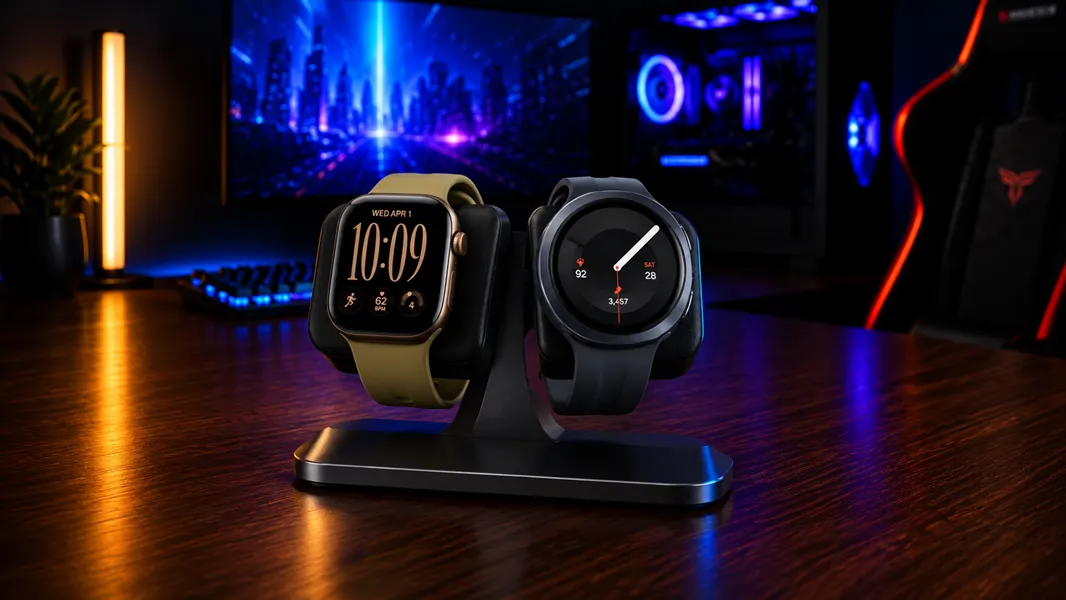
Before comparing specs, it’s worth saying plainly: the Apple Watch Series 12 only works with an iPhone, and the Galaxy Watch 9 only works with an Android phone (Android 13 or later, with Google Mobile Services). Neither watch is cross-compatible. So for the vast majority of readers, this isn’t really an “either/or” comparison — your phone already made the decision. This guide is most useful if you’re deciding which phone and watch ecosystem to commit to, or if you’re just curious how the two compare on paper.
Price comparison
| Apple Watch Series 12 | Galaxy Watch 9 | |
|---|---|---|
| Starting price | $399 (42mm) | $379.99 (40mm, Bluetooth/Wi-Fi) |
| Larger size | 46mm | 44mm — $409.99 |
| Cellular option | Available, adds cost | LTE model — $429.99 (40mm) / $459.99 (44mm) |
| Release date | September 18, 2026 | August 7, 2026 |
The Galaxy Watch 9 undercuts the Apple Watch Series 12 by about $20 at the entry tier, though Samsung raised its own price by $30 over the previous generation, so neither brand is getting cheaper year over year.
Design and display
Both watches keep the same silhouette as their predecessors — this is an internals-focused generation for both companies, not a redesign year.
The Apple Watch Series 12 sticks with 42mm and 46mm case sizes, offered in aluminum and titanium, with a new ceramic case option returning for the first time since 2019 (available in white and dark gray). It also picks up Ceramic Shield 2 on the aluminum models for added scratch resistance.
The Galaxy Watch 9 comes in 40mm and 44mm sizes, both with a Super AMOLED display (1.34-inch on the 40mm, 1.47-inch on the 44mm). Samsung skipped a Classic model this year, so there’s no rotating bezel option — just the standard case with two side buttons, in Cream/Graphite (40mm) or Silver/Graphite (44mm).
Performance and chip
This is the headline upgrade on both sides, even though neither watch changed its exterior.
The Apple Watch Series 12 runs Apple’s new S11 chip — the first meaningful processor upgrade since the S9 in 2023 (the Series 10 and 11 both reused the S10 with no real performance gain). The S11 is what enables the on-device processing behind Siri AI and the new Audio Intelligence features.
Galaxy Watch 9 moves to the Snapdragon Wear Elite platform (a five-core CPU paired with an Adreno A622 GPU), with 2GB of RAM and 32GB of storage. Samsung says this delivers roughly 30% better power efficiency than the outgoing chip, which shows up directly in the battery numbers below.
Battery life
| Apple Watch Series 12 | Galaxy Watch 9 | |
|---|---|---|
| Rated battery life | Up to 24 hours | Up to 30 hours (40mm) / 40 hours (44mm), AOD off |
| With always-on display | 24 hours (unchanged) | Shorter, exact figure varies by use |
| Charging | Fast charging, wired | Up to 10W wireless |
Samsung has a clear edge here. The Galaxy Watch 9’s efficiency gains from its new chip translate into meaningfully longer runtime, especially on the 44mm model. Apple’s Series 12 keeps the same 24-hour rating it’s had for several generations — the faster charging helps in practice, but it doesn’t close the gap on paper.
Health and fitness tracking
Apple’s headline addition is Readiness, a daily 0–10 score calculated each morning from recent activity, sleep, vitals, and recovery data, then updated throughout the day. It’s paired with an upgraded Sleep score and HRV tracking that now runs both overnight and during the day, thanks to a redesigned Health Sensing System that samples heart rate far more frequently than before. Blood pressure monitoring and a microLED display were both rumored ahead of launch but did not make it into this generation.
Samsung’s Galaxy Watch 9 leans into a similarly data-heavy approach: a revamped health dashboard with a heart health score, daily cardio load, a fitness index, and hearing health monitoring. It also offers cuff-calibrated blood pressure readings in regions where the feature is approved — something Apple still doesn’t offer on Series 12.
AI features
Both companies pushed hard on on-device AI this generation, with different scopes.
Apple’s Siri AI adds natural, back-and-forth conversation directly on the wrist, including workout brainstorming and wellness tips, rolling out in English first. Audio Intelligence (Live Rewind, Siri Recap, Sound Recognition, and faster Shazam detection) arrives in beta later in 2026, but requires an Apple Intelligence–enabled iPhone 16 or later, and some server-side features carry daily usage limits.
Samsung’s Galaxy AI integration on the Watch 9 focuses more on personalized recommendations and smarter interactions within Samsung Health and One UI 9 Watch, rather than a conversational assistant experience.
Software support
Samsung is promising 5 years of OS upgrades for the Galaxy Watch 9, running One UI 9 on Wear OS 7 — up from 4 years on the Galaxy Watch 8. Apple hasn’t published an equivalent commitment for Series 12, though its watches have historically received several years of watchOS updates as well.
Full spec comparison
| Spec | Apple Watch Series 12 | Galaxy Watch 9 |
|---|---|---|
| Starting price | $399 | $379.99 |
| Sizes | 42mm, 46mm | 40mm, 44mm |
| Chip | Apple S11 | Snapdragon Wear Elite |
| RAM / Storage | Not disclosed by Apple | 2GB / 32GB |
| Battery | Up to 24 hours | Up to 30–40 hours |
| Charging | Wired, fast charging | Up to 10W wireless |
| Connectivity | 5G (cellular models), Bluetooth 5.3 | LTE (select models), Wi-Fi 6, Bluetooth 6.0, NFC, UWB |
| Durability | Ceramic Shield 2 (aluminum) | IP68, 5 ATM, MIL-STD-810H |
| OS | watchOS | Wear OS 7 (One UI 9 Watch) |
| Phone compatibility | iPhone only | Android only |
| Update commitment | Not disclosed | 5 years |


Which one should you buy?
- You have an iPhone: get the Apple Watch Series 12. There’s no real alternative in this comparison for you, and the Readiness score plus Siri AI are genuinely useful additions if you’re coming from an older Apple Watch.
- You have an Android phone: get the Galaxy Watch 9. Longer battery life, a lower entry price, and a 5-year update commitment make it the stronger value story this generation.
- You already own an Apple Watch Series 11: this is a skippable upgrade. The chip jump matters for AI features you may not use yet, but the hardware itself isn’t dramatically different.
- You already own a Galaxy Watch 8: also skippable for most people — Samsung rolled several of the new health features back to the Watch 7 and Watch 8 via a software update in June 2026, so you may already have them.
Frequently asked questions
Can I use an Apple Watch Series 12 with an Android phone, or a Galaxy Watch 9 with an iPhone?
No. Both watches are locked to their respective phone ecosystems — Apple Watch requires an iPhone, and Galaxy Watch requires an Android phone with Google Mobile Services. This isn't a software limitation that might change later; it's a fundamental part of how both platforms are built.
Which one has better battery life?
The Galaxy Watch 9, by a meaningful margin — up to 30 hours on the 40mm model and 40 hours on the 44mm (with always-on display off), compared to the Apple Watch Series 12's 24-hour rating.
Is the Apple Watch Series 12 a big redesign?
No. Apple kept the same case sizes and general design as recent generations, focusing this cycle on the new S11 chip, health sensors, and AI features rather than a physical redesign. A larger redesign has been rumored for a future generation.
This comparison is based on official specifications and pricing from Apple and Samsung as of September 2026. Prices and availability may vary by region and change over time — check current listings before buying.
Where to buy
Apple Watch Series 12 GPS 46mm Smartwatch — $499.00. Buying through the link below supports Decode Layer at no extra cost to you.
Affiliate link. As an Amazon Associate, we may earn a commission from qualifying purchases.