The 7 Best Wireless Security Cameras of 2026: Price, Battery, and Real Cost Compared
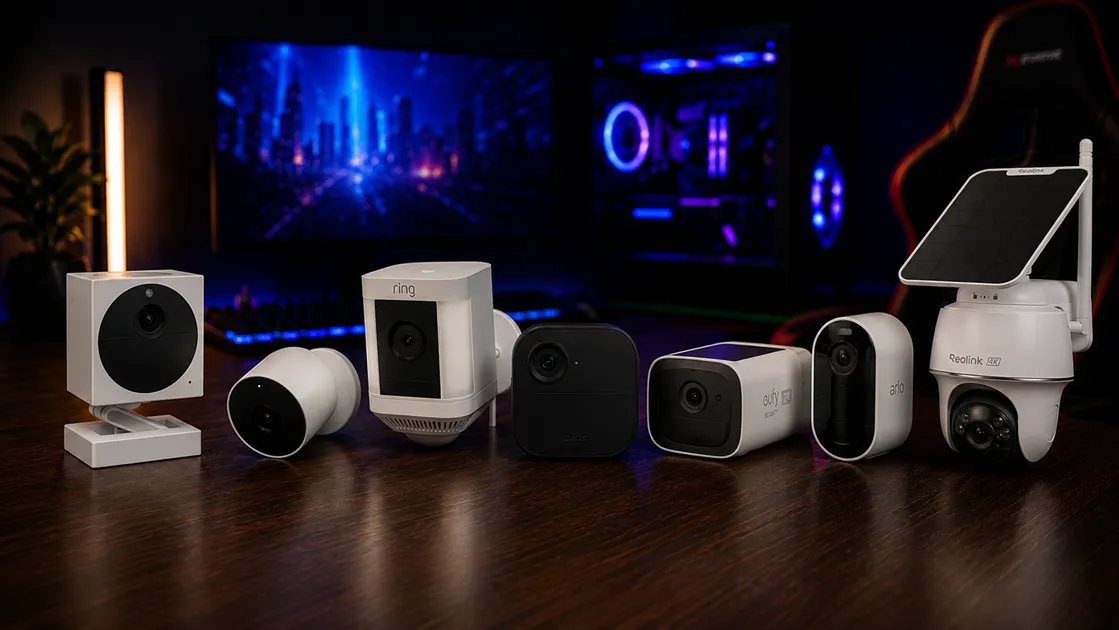
Wireless security cameras have come a long way in recent years — today it's possible to protect your entire home without drilling into walls or paying a mandatory monthly fee. We compared the most reliable options on Amazon, looking at video resolution, battery life, real first-year cost, and how easy each one is to install.
Main keyword: best wireless security cameras 2026
Updated August 2026.
| Camera | Resolution | Battery/Power | Storage Without Subscription | Best For |
|---|---|---|---|---|
| Reolink Argus PT 4K+ | 4K (8MP) | Rechargeable + built-in solar | Yes (local microSD) | Resolution and 360° coverage |
| Arlo Pro 5S 2K | 2K HDR | Removable battery | No (full features require subscription) | Alexa/Google/HomeKit integration |
| eufy SoloCam S220 | 2K | Built-in solar | Yes (8GB built-in) | No-subscription value |
| Ring Spotlight Cam Plus | 1080p | Removable battery | No (most features require Ring Protect) | Existing Alexa ecosystem users |
| Google Nest Cam (Battery) | 1080p HDR | Rechargeable battery | Partial (3h free, rest requires Nest Aware) | Smart person/animal/vehicle detection |
| Wyze Cam Outdoor v2 | 1080p | Up to 6 months per charge | Yes (local, optional CamPlus) | Lowest upfront investment |
| Blink Outdoor 4 | 1080p | Up to 2 years (AA batteries) | Yes (local Sync Module) | Battery life |
How We Evaluated These Cameras
Our comparison considered four main criteria, gathered from official manufacturer specifications, Amazon product pages, and independent reviews from outlets specialized in CCTV and home security: image quality (resolution and night vision), battery life and installation (battery duration, presence of a solar panel, setup complexity), real cost (purchase price plus any subscription required for essential features), and ecosystem (compatibility with Alexa, Google Assistant, and Apple HomeKit).
We did not physically test all 7 units side by side; this comparison is based on official specifications and analysis of public reviews. Prices and specifications may change — always check the current details on the buy button before deciding.
1. Reolink Argus PT 4K+ — Best Resolution and 360° Coverage
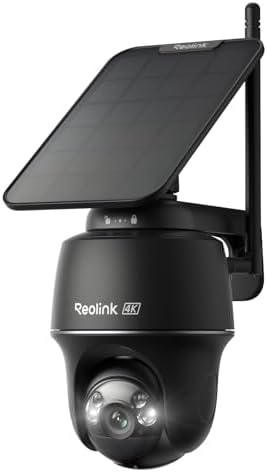
- 4K 8MP Color Vision Day & Night: The outdoor security camera is upgraded to 4K 8MP ultra-high definition, providing unpa…
- Auto-Tracking & 360° Coverage: 355° Pan and 140° Tilt rotation allows for monitoring with no blind spots. Intelligent au…
- 100% Wireless Installation + Detachable Solar Panel: No wiring needed. Easy, flexible setup with a detachable 3W solar p…
If image resolution is your priority, the Argus PT 4K+ leads the group with 8MP (4K) and color night vision sharp enough to identify a face at 20 feet or a license plate at 100 feet. Its mechanical standout feature is 355° horizontal and 140° vertical pan/tilt with auto-tracking — the camera rotates on its own to follow movement in the scene, covering a much larger area than fixed cameras. It’s powered by a rechargeable battery with a built-in solar panel (just 20 minutes of daily sunlight keeps it charged), and records to a local microSD card, with no mandatory cloud storage fee.
| Pros: | Cons: |
| + 4K (8MP) resolution with automatic 360° tracking + Built-in solar panel, no manual recharging needed + Local storage with no mandatory subscription + Dual-band Wi-Fi (2.4GHz and 5GHz) | − Doesn’t record continuously (motion events only), due to battery − More complex app and initial setup than competitors − No native Apple HomeKit support |
2. Arlo Pro 5S 2K — Best Ecosystem and Smart Home Integration

- Premium Outdoor Wireless Camera 2K HDR Video (1 Camera): Watch, listen & talk. Monitor your home, property with 2K HDR v…
- See sharper details with 2K HDR (High Dynamic Range) Video & Zoom: Everything in picture perfect detail with the power t…
- Don’t miss a moment with the Arlo Secure App: Get real-time notifications with motion activation & live video streaming …
The Arlo Pro 5S 2K delivers 2K HDR video with 12x digital zoom and a 160° field of view, plus a built-in spotlight to deter intruders at night. Its biggest strength is compatibility: it works with Alexa, Google Assistant, and Apple HomeKit — covering practically any smart home ecosystem a user might already have. Setup is quick, with a removable, rechargeable battery.
The thing to watch out for is total cost: the list price is around $100, but it’s usually found for $90–150 during sales — worth checking around before buying. On top of that, the more advanced features (person/vehicle/package detection, 60-day recording) depend on an Arlo Secure subscription.
| Pros: | Cons: |
| + Compatible with Alexa, Google Assistant, and Apple HomeKit + Sharp 2K HDR video, with 12x zoom + Removable battery, easy to swap/recharge + Simple setup through the app | − Advanced detection features require an Arlo Secure subscription − High list price (though it often drops a lot during sales) − No continuous recording without a paid subscription |
3. Eufy SoloCam S220 — Best Value Without a Subscription

- Continuously Powered by Solar: Just 3 hours of sunlight is enough to keep the camera running. The tiny size and wire-fre…
- Day and Night Clarity: Infrared LEDs and an f/1.6 aperture allow more to be seen for excellent night vision.
- Easy Installation: Use anywhere thanks to its tiny size and wire-free design. Drill one hole, once.
The eufy SoloCam S220 is the right pick for anyone who wants to get set up with the smallest possible investment and zero monthly fees. It comes with 8GB of built-in storage already included (no SD card or subscription needed), an integrated solar panel that keeps the battery charged with just a few hours of sun a day, and 2K resolution that’s plenty for most home uses.
It’s a simpler camera — no pan/tilt, no advanced AI detection by default — but it handles the essentials well: monitoring an entrance, backyard, or garage without hassle or recurring cost.
| Pros: | Cons: |
| + No monthly fee, with 8GB of built-in storage included + Integrated solar panel, practically “install and forget” + Much lower price than Arlo/Ring/Nest + Simple installation, no wiring | − 2K resolution, below the Reolink’s 4K − No pan/tilt (fixed camera) − Doesn’t support cloud storage, only local/HomeBase |
4. Ring Spotlight Cam Plus — Best for Existing Alexa Users
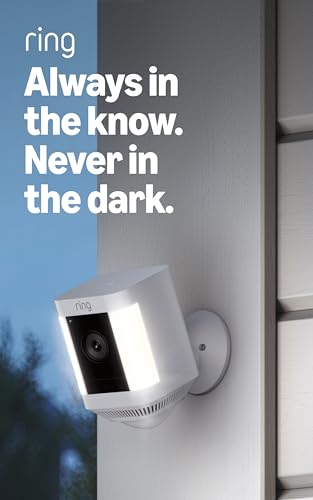
- Look in anytime – Watch over your home or business day or night in wide-angle, 1080p HD video with Color Night Vision an…
- Stop intruders in their tracks – With 2 motion-activated LED spotlights that turn on when they detect motion, and sound …
- Focus on important areas – Customizable motion zones let you choose exactly what your camera covers – so you only get no…
With two motion-activated LED spotlights and a built-in siren, the Ring Spotlight Cam Plus is the strongest option for anyone who prioritizes visual and audio deterrence against intruders. Its integration with Alexa is the standout feature: automatic audio announcements when motion is detected, streaming to Echo Show, and voice control.
As with the entire Ring lineup, the most useful day-to-day features (up to 180 days of recording, person/package alerts) depend on a Ring Protect plan, sold separately — without it, the camera works basically as live view only.
| Pros: | Cons: |
| + Dual spotlights + built-in siren, great for deterrence + Deep integration with Alexa and Echo + Removable battery (Quick Release), easy to swap + Simple installation, no wiring | − Most useful features require a Ring Protect subscription − No support for Google Assistant or Apple HomeKit − 1080p video, not 2K/4K |
5. Google Nest Cam (Battery) — Best Smart Detection

- Meet the smarter, sharper wired Google Nest Cam Outdoor; with 2K HDR video and Gemini, it knows what to look out for and…
- Stay in the know with always-on power: Nest Cam Outdoor keeps you plugged into home, day and night, with no need to rech…
- Google Nest Cam Outdoor keeps your data safe with encrypted video, two-step verification, and enhanced security through …
The Nest Cam (2nd generation) stands out for its on-device intelligence: it distinguishes between a person, an animal, and a vehicle directly on the device (without relying on the cloud for that), and can even recognize familiar faces with personalized alerts. It integrates with the Google Home ecosystem, with Alexa support as well.
Without a subscription, you get 3 hours of recorded event history — enough to review something recent, but limited. For 60-day history and full features, a Nest Aware subscription is required.
| Pros: | Cons: |
| + Smart person/animal/vehicle detection processed locally + Familiar face recognition + Strong integration with Google Home and Alexa + Stores up to 1h of recording locally even if internet drops | − Only 3h of free history without a subscription − Full features require Nest Aware − Higher price than eufy/Wyze |
6. Wyze Cam Outdoor v2 — The Cheapest Option

- Rechargeable Batteries: Mount wherever you need a security camera without worrying about running wires or finding outlet…
- Easy Installation: Skip running wires or searching for outlets. Friendly step-by-step guides in the Wyze app make wirele…
- Indoor/Outdoor Camera: This wireless security camera has an IP65 rating, so you can confidently install it outdoors unde…
For anyone who wants the lowest possible upfront investment, the Wyze Cam Outdoor v2 is the most affordable camera on the list, with up to 6 months of battery life and color night vision (Starlight Sensor). It’s the most “no-frills” pick of the group: 1080p resolution (not 2K/4K), and most kits require a separate base station to work — up to 4 cameras per station.
It’s a great entry point for anyone who just wants to try out having a security camera without spending much, but anyone looking for advanced AI features or higher resolution should consider the options above.
| Pros: | Cons: |
| + Much lower price than competitors + Battery lasts up to 6 months per charge + Color night vision with Starlight Sensor + Supports up to 4 cameras per base station | − 1080p resolution, below 2K/4K competitors − Requires a separate base station in most kits − Person/package detection requires a CamPlus subscription |
7. Blink Outdoor 4 — Best Battery Life

- Outdoor 4 is our most affordable wireless smart security camera yet, offering up to two-year battery life for around-the…
- See and speak from the Blink app — Experience 1080p HD live view, infrared night vision, and crisp two-way audio.
- Two-year battery life — Set up in minutes and get up to two years of power with the included AA Energizer lithium batter…
With up to 2 years of battery life using standard AA lithium batteries (instead of a proprietary battery), the Blink Outdoor 4 solves the biggest annoyance with wireless cameras: remembering to recharge. Free local storage via the Sync Module, with no mandatory subscription. 1080p resolution, suitable for basic monitoring but not for identifying fine details.
| Pros: | Cons: |
| + Up to 2 years of battery life with standard AA batteries + Free local storage, no subscription + Wireless installation + Competitive price | − 1080p, not 4K − Doesn’t record continuously − No Apple HomeKit (Alexa only) |
Real Cost in the First Year
| Camera | Approximate Price | Subscription Required for Essential Use? | Estimated 1st-Year Cost |
|---|---|---|---|
| eufy SoloCam S220 | ~US$ 69–99 | No | ~US$ 69–99 |
| Wyze Cam Outdoor v2 | ~US$ 90 | No (CamPlus is optional) | ~US$ 90 |
| Blink Outdoor 4 | ~US$ 37–70 | No (subscription is optional) | ~US$ 37–70 |
| Reolink Argus PT | ~US$ 130 | No | ~US$ 130 |
| Google Nest Cam (Battery) | ~US$ 178 | Partial — full history requires Nest Aware | ~US$ 178 (+ Nest Aware if you want full history) |
| Ring Spotlight Cam Plus | ~US$ 109 | Yes, for most useful features | ~US$ 109 + Ring Protect |
| Arlo Pro 5S 2K | ~US$ 89–99 | Yes, for advanced features | ~US$ 89–99 + Arlo Secure if wanted |
Approximate prices as of August 2026, subject to change with Amazon promotions. Check the current price on each camera’s buy button.
Frequently asked questions
Do wireless security cameras need a monthly subscription?
It depends on the model. The eufy SoloCam S220, Wyze Cam Outdoor v2, and Blink Outdoor 4 all work without any mandatory subscription, using local storage. Ring, Arlo, and Google Nest Cam, on the other hand, require a subscription to access most useful features, like recording history and advanced alerts.
Which wireless security camera has the longest battery life?
The Blink Outdoor 4 leads in this category, with up to 2 years of battery life using standard AA lithium batteries. The Wyze Cam Outdoor v2 comes next, with up to 6 months per charge. Cameras with a built-in solar panel, like the Reolink Argus PT 4K+ and the eufy SoloCam S220, practically eliminate the need for manual recharging.
Do wireless security cameras work without internet?
Most work partially without internet: they record events locally (to an SD card or built-in storage), but real-time alerts, remote viewing, and phone notifications require an active Wi-Fi connection.
What's the difference between 1080p, 2K, and 4K resolution in security cameras?
1080p is enough to identify general motion and recognize people at short range. 2K improves sharpness for details like a face at medium distance. 4K lets you make out fine details, like license plates, at longer distances — but it also uses more storage and internet bandwidth.
Do I need a base station (hub) to install wireless security cameras?
It depends on the brand. The Wyze Cam Outdoor v2 usually requires a base station to work. Blink, Ring, Arlo, eufy SoloCam, and Google Nest Cam connect directly to home Wi-Fi, with no additional hub needed (though some offer optional hubs for extra features).
Do wireless security cameras work with Alexa, Google Assistant, and Apple HomeKit?
It varies by brand. The Arlo Pro 5S 2K is the only one on this list with native support for all three (Alexa, Google Assistant, and Apple HomeKit). Ring and Blink only work with Alexa. Google Nest Cam works with Google Home and Alexa, but not with Apple HomeKit.
Found this comparison helpful?
Feel free to link to this article as a reference.
Nota de transparência: este conteúdo pode conter links de afiliado. Se você comprar através deles, o Decode Layer pode receber uma comissão, sem custo adicional para você.